
TL;DR
Hardware-rooted verification can turn frontier AI safety and security commitments into specific, privacy-preserving claims that external parties can review.
The strongest near-term use case is declared, concentrated advanced-compute environments where operators can install evidence-capture infrastructure.
We are retrofitting a datacenter in Europe to make it verifiable, specifically for claims pertaining to hardware identity and location; whether hardware is being used for training or inference; which model is running on it; and whether information has left an approved environment.
The technology should be treated as an evidence layer, not a complete governance regime. It complements evaluations, security controls, audits, standards, and enforcement mechanisms.
Introduction
This blog translates Lucid Computing’s work on hardware-rooted verification into a general claim-design framework that companies can use if they want to make externally valid claims to other companies, governments, customers, or citizens.
AI verification is the technical governance mechanism for proving claims about AI development and deployment rather than trusting assertions and documentation. It matters because as AI advances, governments increasingly see their options as either invasive surveillance or no oversight at all. AI verification aims to chart a path that avoids both, enhancing security without sacrificing privacy.
The goal is to turn facts about AI models and systems, and the hardware they run on, into specific, privacy-preserving, externally reviewable claims. We do this through “structured transparency,” a system in which agreed-upon collections of facts can be rigorously checked without disclosing model weights, training data, customer data, evaluation sets, or sensitive infrastructure details.1
In its most ambitious form, such a regime may want to verify: how many chips there are and where any given chip physically is (registry and location); what a chip is doing (training vs. inference); how big a training run was (compute thresholds); what data a model was trained on (e.g. biological-sequence data); what a model can or can’t do (dangerous-capability evals).
A brief overview of the verification ecosystem
Verification has been discussed in AI governance research for over half a decade (e.g. Brundage et al., 2020). In this section we briefly map the foundational literature, in order to surface key policy goals for a verification regime.2
Oxford AIGI’s work on verification has been key in seeding a verification ecosystem for international governance. They found that many blunt AI agreements “appear possible even without speculative advances in verification technology”, but more ambitious and robust agreements “will require major investments in developing and installing verification infrastructure” (Harack et al., 2025).
Further work at Oxford AIGI has zoomed in on one specific mechanism for hardware-based verification: designing network taps to enable cryptographic fingerprinting of all traffic entering and leaving a datacenter, to support verification that no undeclared workloads were covertly exfiltrated from the cluster (Cankaya et al., 2026).
AVERI has also outlined a roadmap to get from unilateral declarations to nation-state-robust agreements. They proposed four “assurance levels,” eventually reaching very high assurance (AAL-4), which relies on “[c]ontinuous verification designed to detect active deception attempts […] providing ‘treaty-grade’ confirmation of the company’s risk profile” (Brundage et al., 2026).
MIRI’s work has been critical in surveying the range of possible technical interventions to support international verification, mapping prior work and assessing feasibility. Through this mapping, they organize the verification landscape around three illustrative policy goals: locating AI compute; verifying that some known compute is not being used for a large training run; verifying the authenticity of model evaluations (Scher and Thiergart, 2025).
Recent work by AI Futures Project suggests verification tech as a key enabler of their “Plan A,” with their immediate priorities (in terms of technical compute-based interventions) in line with two of the three policy goals MIRI identified: 1) compute accounting and tracking to know how much AI-relevant compute exists in the world and which entities are in possession of it; 2) retrofitting datacenters to make them inference-only.
Beyond privacy-preserving verification for international agreements, researchers have outlined how hardware-rooted, privacy-preserving verification can support increased AI diffusion while limiting misuse, IP exposure, and compliance burdens (Ammann and Dalrymple, 2025).
All of this work informs our own to some degree. We aim to contribute to this ecosystem through our work to advance the theory and practice of verification.
Verification is about designing and validating claims
The verification problem is best understood as a claim-design problem. A useful verification system starts with a narrow decision-relevant claim, specifies what a verifier is allowed to learn, and what evidence the prover must supply. This evidence should only be the specific pre-determined information needed to assess compliance. It should not expose IP or sensitive data.
Different regulatory regimes will require different claims. For example, a compute-cap regime would need evidence about total compute consumed, whereas an inference-only regime would need evidence about workload class.
In this context, “proof” should not always be read as mathematical certainty. Some claims can be supported by strong cryptographic evidence (stemming from the hardware root-of-trust), such as signed attestations from enrolled hardware or timestamped workload declarations. Other claims are evidentiary or probabilistic, such as whether observed behavior is consistent with inference-only reference data. The point is to make the strength of each claim explicit rather than to overstate what verification can establish.
It is also important that a verification architecture separates evidence capture from evidence evaluation. For example, sensitive data can remain inside compute clusters, while pre-agreed claims leave the facility as signed receipts.
The approach is strongest when claims are standardized enough for independent review but flexible enough to support different policy regimes, such as compute caps, certified-model deployment, inference-only commitments, data-boundary guarantees, or incident-specific assurance.
Translating policy objectives to verifiable claims
To show how a claim-design framework can be used to turn policy objectives into real-world proofs, we will use our European datacenter retrofit program as a case study.
We take high-level policy goals identified by Scher and Thiergart:
locating AI compute
verifying that enrolled compute is not being used for a large training run
verifying the authenticity of model evaluations.
We operationalize these into verifiable claims, and identify which technical tooling will be needed in the datacenter to validate the claims. The final step is red-teaming what we’ve built with a government funded research institute’s cyber team to ensure robustness.
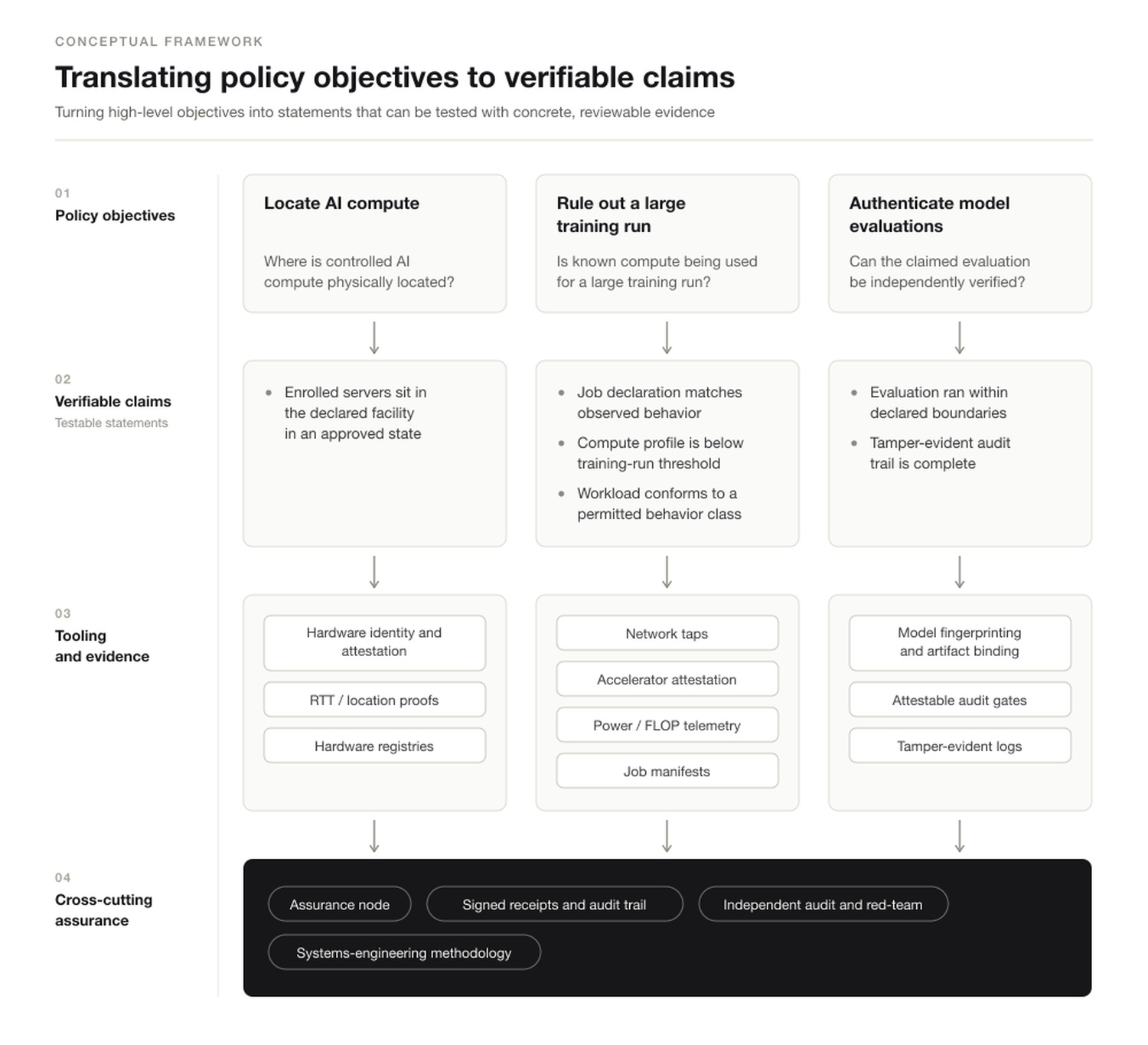
We would be excited to see many more teams build their own reference architectures against specific claims, with the goal being ”radical optionality” rather than just having one plan.
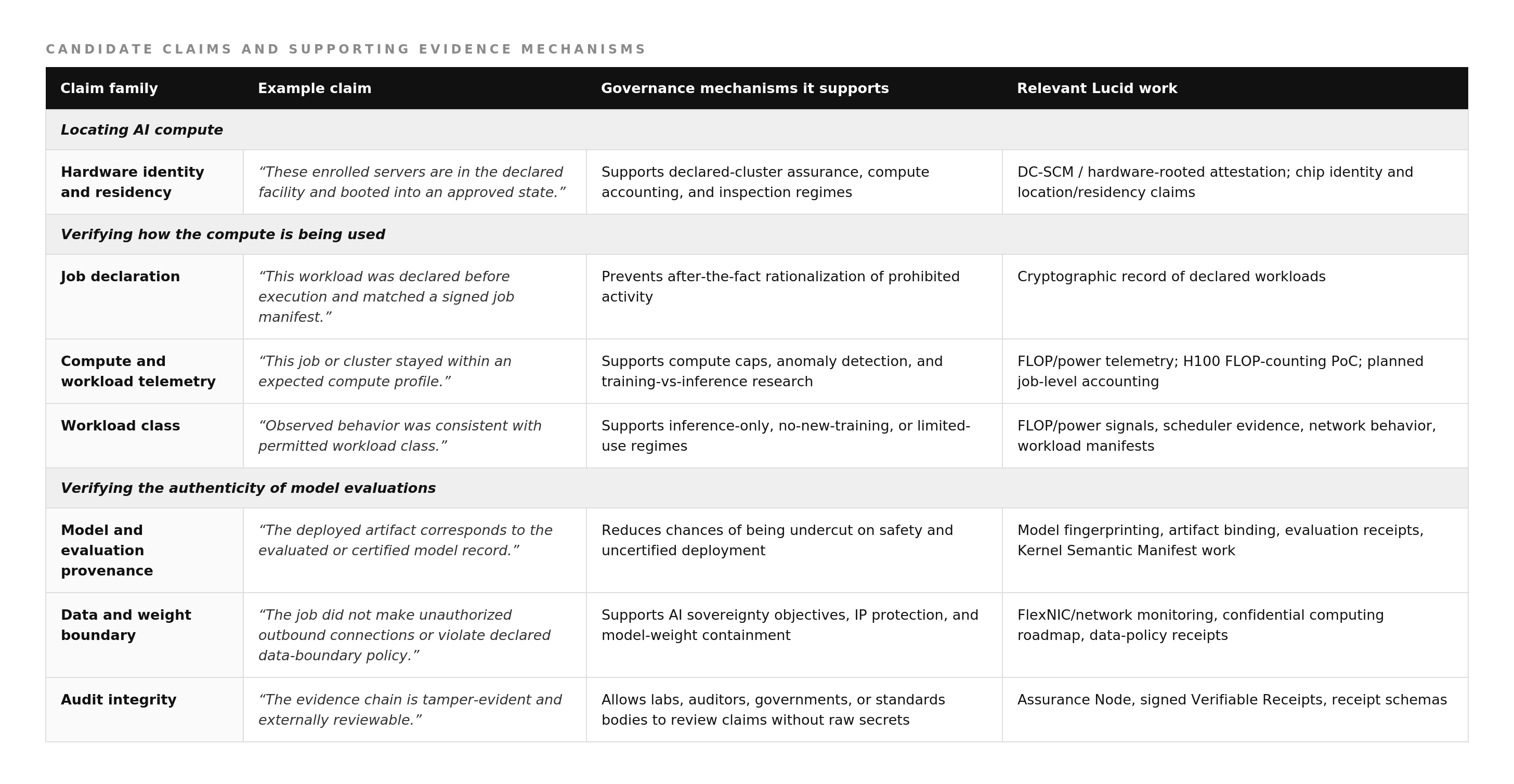
Building, breaking, and iterating many different techniques will surface the most viable options for a controlled acceleration at a critical juncture. For an overview of the claims for which we are currently building verification solutions, see the table below.
What does this mean?
Hardware-rooted verification is most tractable for declared, concentrated advanced-compute environments (see A.1). It is not, by itself, a solution for every verification problem in frontier AI governance.3
However, we believe it is the most viable means to make externally reviewable claims about AI development, should relevant actors want to. This blog outlined one claim-design framework for doing so.
In the end, verification technology will only be as useful as the claims it can support. The most valuable near-term work is to move from broad aspirations about AI assurance to specific, testable, privacy-preserving claims about declared AI infrastructure and digital artifacts.
We are contributing by building a hardware-rooted verification stack to help frontier AI developers and external stakeholders establish evidence about where advanced compute is, how enrolled compute is being used, whether workload and model records match declared policy, whether sensitive artifacts remained within approved boundaries, and whether audit evidence is tamper-evident. We are excited to see alternative claim-design frameworks, verification goals, reference architectures, and red-teaming projects emerging.
If you are working on any of this, get in touch! We are hiring.
Appendix
A.1 Why start with declared AI datacenters?
Declared AI datacenters are not the whole verification problem, but they are the right starting point for six reasons.
First, they concentrate the vast majority of the most relevant compute. Frontier-relevant training and large-scale AI R&D depend heavily on advanced accelerator clusters, high-bandwidth networking, power, cooling, storage, and operational expertise. This makes large declared datacenters more tractable verification targets than dispersed or covert compute.
Second, declared facilities are where cooperation is easiest. A verification regime that requires every adversary to be cooperative would fail, but many useful regimes begin with declared assets: facilities that participants agree to register, instrument, and make subject to challenge. Hardware-rooted evidence capture is most useful in these settings because the operator can be required to install and maintain verification infrastructure.
Third, declared datacenters are where privacy-preserving verification is most urgently needed. Frontier labs and cloud providers cannot simply disclose raw logs, model weights, training data, customer workloads, evaluation sets, or internal infrastructure details. If verification cannot be made compatible with confidentiality, it will not be adopted. This makes minimal-disclosure receipts and hardware-rooted claims central to any practical regime.
Fourth, declared datacenters provide a realistic testbed. Abstract verification proposals are useful, but the field needs concrete reference architectures that can be installed, attacked, measured, and improved. A red-teamable cluster can reveal which claims are feasible, which claims are brittle, and which require additional institutional or technical support.
Fifth, declared-cluster verification composes with other regime tools. It does not replace procurement intelligence, export controls, inspections, chip-vendor cooperation, or enforcement. But it can provide the technical evidence layer those mechanisms need. For example, procurement controls can help identify relevant chips, while datacenter verification can help determine whether participating clusters are being used consistently with declared commitments.
Sixth, this focus creates a path from near-term deployment to stronger regimes. A pilot that can verify limited claims on a cluster with 16 H100s does not prove frontier-scale pause verification. But it can establish schemas, evidence chains, threat models, and red-team methods that later scale to larger clusters, more vendors, more facilities, and more demanding claims.
A.2 What this focus does not solve
The declared-datacenter focus leaves important problems unresolved. We think it is important to state these limitations explicitly. These limitations should be taken as a means to define the role of verification of declared clusters, i.e., it is a necessary evidence layer for a broader regime, not the entire regime.
Covert clusters. Actors may hide chips or facilities outside the declared regime. In a broader regime: procurement intelligence, export controls, inspections, whistleblower channels, and chip-vendor cooperation.
Smuggled or undeclared chips. Verification infrastructure cannot attest chips that were never enrolled. In a broader regime: chip registration, supply-chain controls, KYC, customs enforcement, and intelligence-sharing.
Dispersed consumer/prosumer compute. Some AI R&D may move outside large datacenters. In a broader regime: separate monitoring and policy tools, with focus first on frontier-relevant concentrated compute.
Hostile states with physical control. A state-level adversary may attack hardware, supply chains, or facilities directly. In a broader regime: defense in depth, inspections, intelligence, sanctions, and longer-lead hardware-security work.
Training-vs-inference ambiguity. Some workloads are hard to classify from telemetry alone. In a broader regime: representative workload taxonomies, adversarial tests, multi-signal classifiers, and agreed confidence thresholds.
Model identity complexity. A “model” may include adapters, quantization, tools, prompts, RAG systems, policies, and scaffolds. In a broader regime: model/eval provenance graphs rather than single weight hashes.
Algorithmic progress below compute thresholds. Compute caps do not prevent all capability gains. In a broader regime: combine compute verification with eval governance, model provenance, and restrictions on autonomous AI R&D.
Verifier trust. The evidence aggregator or certifier could become a single point of failure. In a broader regime: open schemas, independent verifier software, transparency logs, key revocation, third-party audits, and standards.
Changelog
[July 28 2026] — Published.
“A system exhibits structured transparency to the extent that it conforms with a set of predetermined standards about who should be able to know what, when they should be able to know it, and what they should be able to do with this knowledge; in other words, if it enforces a desired information flow” (Trask et al, 2020).
We do not attempt a comprehensive technical literature review. For this, please see Will Hodgkin’s bibliography of technical research and Amodo Design’s SitRep.
Specifically, it cannot attest hardware that was never enrolled. It cannot find every covert cluster. It cannot eliminate all ambiguity between workload classes. It cannot determine that an AI system is safe merely because a model passed an evaluation. It cannot prevent capability gains from algorithmic progress below a compute threshold. For additional discussion of the limitations of a verification approach that focuses only on declared datacenters, see Appendix A.2.